There’s a saying in French here “Ca va aller.” It basically means, “It’ll be fine” or “Don’t worry about it.” It’s a very useful saying here. It works when I’m frustrated about something, when I’m stressed out about something, or when I don’t know what’s going on. It also works when I don’t understand what people are saying to me in French. I say it and people seem to just laugh. I have a feeling that “Ca va aller” may be a theme throughout my next two years here…

Monday, March 5, 2012

Hot season has arrived…

And I swear it’s hotter than last year.  The nice, cool breeze has now turned into a heater blowing hot air at your face.  If I get water at the pump and leave it in my house, the next afternoon, it is too hot to shower with. 

Work is going great, still super busy.  We finished the HIV awareness project we were working on.  IMG_4572 We did a mural at the primary school, an HIV lesson with the oldest primary school students, a community awareness day, and three theatre performances.  The picture to the right is from the community awareness day – it’s me with all the community health agents.  The other picture is from one of our theatre performances.  It’s been very interesting talking to people about HIV and seeing the cultural differences in how people view HIV.  One of the most interesting is talking about what advice you give to people living with HIV and their loved ones.  I was at the pump one day and a woman was asking me about HIV.  And she said (granted in Bissa so this is a rough translation,) that HIV wasn’t a problem anymore because now there is medicine for it.  Yes, ARVs are available (actually for free here IMG_4618at the district hospital), but it’s not a cure.  It makes sense why people might think that because in pushing for early testing, people always talk about the free meds and it can easily be misinterpreted.   So, while we were planning the theatre performance, I wanted the group to be very clear that the ARVs are not a cure, but something to prolong life and that once a person has HIV, they always have HIV.  It’s important for them to know that so they act responsibly and prevent transmitting HIV to others.  The community health agents took issue with that because they said culturally, you don’t tell someone so directly such bad news.  You should say that they will get better.  It’s a tough balance between being culturally sensitive but presenting correct and important information.  

I have continued health classes at the secondary school.  There are six classes, so I do each topic with each class before moving on to the next one.  This is probably my favorite activity because I really enjoy working with the secondary school students.  We are now doing an HIV/AIDS lesson.  I love how interested the students are, open, and willing to ask questions.  They can be challenge (for instance a lot of “well what if…, couldn’t that transmit HIV” questions), but it’s a good thing that they don’t just take what people tell them, but they think about it and challenge it.  And just last week, I started what will be a weekly thing with the English class at the secondary school.  We do activities so the students get a chance to practice speaking English.  I am trying to incorporate life skills and health topics.  Last week we discussed goal setting.  This week, we will have a discussion related to Women’s Day which is Thursday.

I have also started another malnutrition program.  We weighed babies in 2 villages and identified malnourished children.  We get together twice a week to do a cooking demonstration and talk about different health topics.  It’s been a lot of fun and the women involved are great.  They seem really motivated and interested in learning about health so they can help their children.  We’ve focused on malnutrition, but also incorporated other things that relate.  For instance, if a malnourished child or child at risk of malnutrition is sick, they will not gain weight.  Therefore it is really important that the mothers prevent against other sickness, particularly malaria and hygiene-related illnessIMG_4587.  The only frustration is just people showing up late, but other than that, things are going well.

In honor of Super Bowl Sunday, I made buffalo wings (actually the whole chicken) and had ranch and hot sauce for dipping.  I explained to my family that men watch for the game, women watch for the commercials.  To the right is my Super Bowl chicken that I bought at the marche and biked home on my handlebars.     

This past weekend, I traveled to Dedougou with other volunteers to go to the mask festival.  IMG_4647It was awesome!  So they use the French word for mask to describe it, but it’s really full costumes.  They came from all over West Africa and the significance varies by region, but usually they appear at funerals and are in general associated with animist religious practices.  We don’t have them in my region, so it was interesting to see this aspect of traditions here.  There were performances, but then all the groups also walked around the town in their masks as well.  At a village ceremony, you are not allowed to take pictures, but for the festival, you were allowed to photograph.   One night, we were walking through the craft mIMG_4648arket and saw one of the masks walking around.  The picture to the left is while he walked by.  When you do take pictures, you give a small contribution.  So when he saw the flash from my first picture, he turned around and approached me.  We were eating dinner so under a tent.  I took the picture to the right as he ducked to leave the tent after I gave him some money.  The other photos are from performances.    

IMG_4631   cropped mask festIMG_4633 IMG_4637

Saturday, February 4, 2012

Only in Burkina Faso, Part 2

I know a little late, but Happy Holidays!  I hope that you enjoyed the season and got to celebrate with people you love.  The holidays here in Burkina were exciting this year.  For Christmas, I went with a few other volunteers to an elephant park.  We went out on one ride through the park and saw just about all the types of animals that are here in Burkina (no, there are no lions here, no there are no giraffes).  That included lots of elephants and a few different sorts of antelope-type animals.  On our way out of the park, we saw a baby elephant in a group of adult female elephants.  He was encircled by the herd as he played in the mud.  At one point, one of the adult elephants actually sat on him.  We were a little worried as he struggled, but apparently they were just playing.  After a little bit, one of the elephants noticed us, slowly walked away from the group, trumpted to warn us, and then charged towards our car.  I mean, what would you do if a bunch of people were watching your kid play? (Pictures coming soon – they charged per camera, so we shared a camera and I still need to get the pictures.)

I celebrated New Year’s back in village.  The day before New Year’s Eve, I went into my district capichieftal for a traditional Bissa New Year’s celebration at the chief’s house.   There were TONS of people there – crowd certainly wasn’t as big as Inauguration Weekend in DC, but I’d say my fear of being trampled was equal.  They were doing crowd control on horseback.  And by they, I don’t mean a police officer trained in crowd control or even horse back riding.  I mean a few random guys in the chief’s family.  To get people to move back, they charge towards them on the horse.  It gets people to move, but is also causes people in the back to randomly start getting pushed back by everyone in front of them.  I went with a cousin of the director of the school in my village, and I clung to her for dear life.  The ceremony was pretty basic – the chief came out, walked down the aisle of tons of people, anddancers sat down to make the sacrifice.  I was expecting a chicken or goat, but all I could see him put down were a few feathers, some dolo (local millet beer), and a few other random trinkets.  Not like I really would have watched a goat or chicken be sacrificed anyways.   Then, men played the drums for the chief and women danced.  I tried to ask my friend the significance of the ceremony, but I really couldn’t get more out of her than the basics – health and luck in the new year.  The next day, I went back to village for the real New Years.  I made a village version of Pad Thai for my family and then we went to see a concert.  So I thought that celebrating at midnight was a universal thing.  But apparently it’s not.  I was counting down, watching my phone.  But when it turned midnight, no one seemed to notice.  It took about five minutes for people to start realizing midnight had passed and slowly, people started cheering and celebrating in their own way.  Time is not as fixed of a concept here as it is in the States.  Sometimes for a meeting or activity, a sufficient meeting time to set is simply morning.   

So I usually think I’ve gotten used to most aspects of life here that seemed bizarre at first.  Chasing a chicken out of the maternity ward or my house, cramming onto bush taxis, the market.  But there are still those moments where all I can say is “What now?”  The other day, there was someone that was referred to the district hospital in Zabré from our health clinic.  They had called the ambulance to get him.  My brother, the pharmacist, who also raises and sells livestock, had some turkeys he needed to get to Zabré.  So he asked the head nurse if he could take advantage of the opportunity and put them on the ambulance too.  And yes, he sent his turkeys to sell at the market in Zabré with the ambulance.  How many health codes would that break in the States?   The next day, I had just arrived home from the market when my mom pointed towards the path leading to our house – there were two camels.  Now I don’t live in the desert, but the northern part of the country is the desert.  There were two men ridding the camels.  They had

camels

left the north and were riding around the country begging essentially.  They go house to house asking for money or millet.  Camels are surprisingly tall.  They are also quite loud, particularly when someone tries to mount them.  Only in Burkina Faso.  

Monday, November 28, 2011

Only in Burkina Faso

November’s been an exciting, but busy month. It’s flown by! I can’t believe I’ve been here for 17 months already! Wow, and just thinking about the fact that next Thanksgiving I’ll be at home celebrating with my family, crazy.

At the beginning of November, we celebrated a Muslim holiday called Tabaski.  On Tabaski, Muslims sacrifice a sheep. It’s a big party in my village. I was on my way back to village that day – I was on transport in the morning, but got to celebrate with my family in the evening. The day before, I was in the capital city. It was really funny to see sheep and chickens invading the streets. Because of the upcoming holiday, people were selling sheep and chickens everywhere, and I mean everywhere. The sides of the road were lined with them. Here, it goes without saying that they’re live animals. People rode their motos, even bikes, with a sheep attached to the back or between their knees. I was in a cab on my way downtown to run errands. The guys in the cab happened to be Bissa, so we chatted as much as my Bissa would allow me to. All of a sudden, I heard a noise and pounding from the trunk. It seemed as if someone was trapped there and trying to get out. All I could think was “what sort of cab did I get into?” Then I heard what sounded like a baby screaming when I realized it was a sheep. Sheep’s “bah” sounds exactly like a baby. I could feel the sheep kicking in the trunk on my back against the seat. The weird part – none of this seemed unusual to me. When I realized it was a sheep, I was like, “Oh yeah. Tomorrow’s Tabaski.”

IMG_4511 We also had a fantastic Thanksgiving celebration here in Burkina Faso. I went into my district capital and celebrated with my neighbors. It was a legit Thanksgiving. We bought a turkey, and when I say we bought a turkey, I mean we bought a live turkey, had a neighborhood kid kill it and clean it, and then we cooked it. It was so delicious! This was all accompanied by mashed potatoes, garlic cheese biscuits, green bean casserole, stuffing, cranberry sauce, and pumpkin pie. It was a great way to celebrate and I know I have a lot to be thankful for this year – I’m so thankful for the opportunity to be here, experience a place I never would have known otherwise, live in a fantastic community with a great host family, be inspired and encouraged almost daily, and most importantly, have all the love and support I need back home from my family and friends. I hope you had a wonderful Thanksgiving too with lots to be thankful for!

IMG_4517 IMG_4529

Tuesday, November 15, 2011

Stage, Part II

October 29, 2011

(Stage is French for training period. Also pronounced differently.)

We recently welcomed a new group of 25 trainees to Burkina Faso and I was lucky enough to host 3 of them for demyst, a weekend trip trainees do during their training to see the life of a volunteer. They came to my site about 2 weeks ago. They had been in country for one week and two days when they arrived in my village, so just off the plane. We had a lot of fun and they were a really great group – and really good sports about lots of biking! They arrived in my village on a Thursday. We ate lunch at the marche on the road and then biked back 9 km to my site. We spent the rest of the afternoon relaxing at my house and then went to greet a few people. Despite my insistence to the chief that it was proper for us to go greet him at his house, he insisted that he come greet us at my house (which is really bizarre and not at all traditional for a chief in Burkina, but it’s definitely refreshing to have a chief like him). On Friday, we did a family planning sensibilisation (health talk) at a mosque after the 1:00 pm prayer (Friday 1 pm is the big prayer where everyone goes to the mosque). It overall went really well. The imam was really supportive and I was really happy at the end when he added a comment about how using family planning methods allows Muslims to practice Muslim values but protect women’s health at the same time. Saturday, we went to the marche and then met with the CSPS (health clinic) staff and community governing board. I was really excited to share my experiences and my village because I live in an amazing village with an awesome family. It was also a cool chance for me to look back and reflect on the past 16 months. I don’t always see how I’ve grown, but moments like that, I can.

It was also exciting because I finally got around to doing something I’ve wanted to do for a while (well decorating my house too, but that’s not the important part). I’ve wanted to sensibilise men on family planning for a while. During the family planning sensibilisation, we focused on the importance of family planning and I particularly focused on the role men have in this decision. There’s this approach Peace Corps talks about called Men as Partners. It’s really important, especially here. You can’t empower women without getting the men on board. It would be dangerous to the social dynamics and brews resentment. Any time you talk about women’s development and empowerment, you have to talk about how men are involved, what role they play, and how you can encourage them to be supportive. Anyways, using this approach, I’ve wanted to talk to men about what people usually consider women’s health issues, such as family planning. Because it was successful, I am going to try it in other villages and on different topics (like the importance of giving birth at the health clinic versus at home).

I am now working the training for the new volunteers for a week. It’s exciting, but definitely lots of work. But again, also a good chance for me to reflect back on the work I’ve done the past 14 months, recognize success and see what I can do better and set goals for my last 10 months. It’s also cool to realize how comfortable I am here – I feel adjusted and integrated into my community. Things that I thought would never become easy are second nature now.

Projects in village are going well. Moving forward on the World AIDS Day project. We are doing an awareness campaign. We will train community health agents on HIV and then on World AIDS Day in December, they will do educational activities. We will also have a theatre performance and a soccer game. Right now, I’m trying to get the mayor’s office involved in this as well. School started mid-October, so I’m doing more health classes. Just last week, I went back to the school to do a health class. I am finishing up hygiene (which I started last year, but I wanted to do hygiene with the two newest classes before I move on to a new topic).

Last blog, I mentioned that I was doing the malnutrition program again, but with some modifications. It’s the same thing I did back in May – find malnourished babies and do a rehabilitation program with them. You met with the moms every morning for 12 days, make enriched porridge and do health education – mostly nutrition, but other topics as well as they are intertwined. It’s gotten off to a slow start this time. While it’s cool that I have 3 counterparts trained on the program and it’s a chance for me to be more hands-off and let them learn by doing and empower them, it’s also logistically less organized. While it may have more bumps along the way now, it leaves them with the skills to do this project when I’m gone.

One thing I’ve learned about malnutrition recently is how much it’s related to so many other health topics. I used to just think about malnutrition in terms of food. But what I’ve seen recently though is that children that are always sick become at risk for malnutrition or fall into malnutrition. A big issue here is hygiene-related illnesses. If a child is always sick with a bacteria infection, parasite, diarrhea, or other hygiene-related illness, they lose weight, lose their appetite, and can’t retain the nutrients they take in, meaning they don’t eat and don’t gain weight. Same thing with malaria. I had a mom come in with her child and the child was moderately malnourished. After talking to her, I realized she understood nutrition and tried to feed her child well, but the child didn’t want to eat and because she was always sick, she was losing weight to the point where she fell below the line into malnutrition. So particularly for malnourished children or children at risk of malnutrition, it is important to talk not only about nutrition, but preventing other illnesses (such as hygiene-related illnesses or malaria) so that the child has the opportunity to eat well and gain weight. That’s one thing we need to focus on more during this second try at the malnutrition program.

I harvested my peanuts finally! As usual, it turned out to be way more work than I expected. Seriously, every time I went to work in my field, I swear it grew larger. Because I only weeded once, it was tough to get to all the plants, but apparently they yielded really well (according to my brother, I have no frame of reference). I averaged about 10-15 peanuts per plant, although some had almost 30 peanuts. Of course, now I’m trying to figure out how to get rid of all these peanuts because I’ll never eat all of them. And I always get gifted peanuts because I live in the peanut region.

Friday, October 14, 2011

NY Times Article: Contraceptives and HIV in Africa

Last week, the New York Times published a front-page article with the results of a study on the effect of contraceptives on HIV tranmission in Africa (sorry, I know I am now a week late on this post, but that’s how things work in Burkina Faso – slow). A recent study suggests that injectable contraceptives, which are widely used in Africa, may increase the risk of HIV transmission and infection. The hormones in the shot seem to have some physiological effect on women, although it is unclear what exactly that effect is and why it doubles the risk of transmission and infection. The study followed couples where one partner was already infected with HIV. In couples where the hormone shot was used, the uninfected partner was almost twice as likely to become infected with HIV during the two years of the study compared to those that did not use the shot. (The study also recorded condom use. Couples using another method of family planning are less likely to use a condom. However, researchers controlled for that and were able to eliminate that as a cause for the increased risk in HIV transmission and infection.) Although the study focuses on eastern and southern Africa, it still applies here in Burkina Faso. While the HIV prevalence rate in Burkina Faso (and West Africa) is much lower than it is in eastern and southern Africa, it is still present and people need to learn how they can protect themselves.

Family Planning in Burkina Faso
Family planning is a huge priority health initiative in Burkina Faso. Education and awareness are really important. During pre-natal consultations, I commonly see women coming in on their 9th pregnancy (although usually not all 8 children are still living). However, especially in a place where maternal and post-natal health care are sub-standard and women generally have to do a lot of physical work often very soon after giving birth, multiple pregnancies without appropriate spacing exhaust a woman’s body and increase the risk for complications. In addition, there are economic and social consequences if you do not have the resources to support all your children. The availability of family planning methods greatly increases the health of women as well as the economic and social dynamics of a community. At the end of the day, there are some people in Burkina Faso that understand the importance of family planning. But there are also some that don’t or don’t accept it and don’t want to talk about it. And even among those who understand the importance, it is hard to translate that attitude into practice for many reasons. There are always exceptions (positive deviants as we like to call them in Peace Corps). I have many conversations in the market about family planning. One man called me over, knowing I work with the CSPS (health center), to show me his wife’s health card and confirm her next rendez-vous at the CSPS for the next dose of the hormone shot. He was involved and supportive of his wife. I have others ask me about the different methods available and where they can go to get them. While I haven’t done much work on family planning in my first year, I definitely want to in my second year and these instances of openness are encouraging, especially knowing there will be just as many instances of restraint and resistance.

According to documents in my health center (CSPS), about 13% of women of procreating age use some method of family planning through the CSPS (hormone shots or pills). This number does not include those who use only condoms, which are available at the CSPS as well as the boutique/store and one of the bars in my village. This may seem low, but considering the cultural norms, access, and education, this is actually pretty good, although there is still much room for improvement. The injectable (hormone shot, what the article is talking about) is by far the most common family planning method used. It is a much more realistic form of family planning here. First – it’s once every three months instead of remembering to take a pill every day. Second, for women whose husbands are not supportive, they can do it quietly at the health center, without their husbands knowing. If she has to take the pill, it is much more likely her husband would find out. (Just to be clear, this is obviously not ideal. It is much more ideal for the men to be supportive and implicated in family planning, not just leave it as a burden for the women or even worse, prohibit it. However, we do not live in an ideal world.) It is always important to emphasize that neither of these methods protect against HIV – condoms do. So even if another method of family planning is being used, condoms should still be used as well. But again, in the case of a husband who refuses to use a family planning method, the shot at least does something. There are other methods of family planning, like implants and intrauterine devices, however those are not available at my health center, but in our district hospital.

HIV in Burkina Faso
The HIV prevalence rate in Burkina Faso, like most West African countries, is much lower than other African countries. Here are some HIV prevalence rates from UNAIDS.

Burkina Faso: 1.2%
Ghana: 1.8%
Côte d’Ivoire: 3.4%
Benin: 1.2%
Togo: 3.2%
Niger: 0.8%
Botswana: 24.8%
Kenya: 6.3%
Uganda: 6.5%
South Africa: 17.8%
United States: 0.6%

Education and awareness are really important in Burkina Faso, both to prevent future transmission of HIV and lower the present rate. There are many misconceptions and just total lacking of information about what HIV is and how it is transmitted. In addition, knowledge on prevention is low and there is still a stigma against those living with HIV. While I do not have a rate for just my health region, I would guess (and it seems to be confirmed through my observations at the CSPS), that it might be slightly higher than the national average because we are by a border and the mines in the region attract many young men from my village to live and work there. These factors and the social effects of them make the population more vulnerable to HIV.

Impact of the study
It seems like officials are trying to be cautious – rightfully so. Sending out alarm signals too soon on the number one family planning method could unnecessarily place women in increased risk. While it is certainly irresponsible to knowingly do something that makes a patient more vulnerable to HIV, the dangers of discrediting or warning against injectable contraceptives in Burkina Faso (I can only speak from my experience here, but it can probably apply elsewhere) are also quite serious. It may mean some women no longer use any family planning method, increasing unwanted and improperly-spaced pregnancies, which would in turn increase injury, illness, and death from complications in childbirth. However, it is just as serious if it is proven true; the public health sector here would have to immediately educate people about other safe forms of family planning and make them available in addition to continuing education on HIV prevention.

Thursday, October 6, 2011

Bikes, Bats, and Burgers

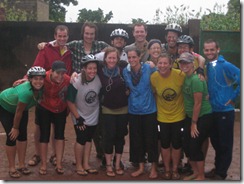
So I’ve had quite an exciting past two weeks. After finishing the malnutrition training in my district capital, I biked back to site to leave the next morning to join the Burkina Faso Bike Tour. It was so much fun! The Bike Tour is a fundraiser put on by volunteers in Burkina Faso to raise money for gender and development projects. The tour went around the entire country, although I only did four and a half days of it. They passed by one of my satellite villages, so I joined en route to Beka. I finished the tour from there into Ouaga (the capital) to celebrate the 50th Anniversary of Peace Corps. IMG_4452 Definitely hard and exhausting, but like every other part of our service, we got through it together and had some fun on the way! We were greeted by a huge welcome ceremony when we arrived in Beka. Literally, the entire village must have come out for it. There were drummers and dancers and of course tons of people just staring at us (we were about 20 people in total). As well as people taking pictures of us with their cell phones (yes, there is no electricity or running water, but don’t worry, you can still take pictures with your cell phone). After our two host volunteers thanked everyone, we presented the chief, mayor, and prefet with certificates to thank them for hosting us. Then we split the men and women and did a health talk – malaria with the men, nutrition with the women. It was really cool how excited everyone was to have us there and a great chance to educate lots of people.

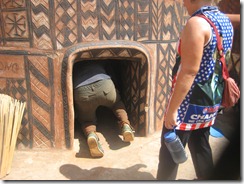
The next morning, we packed up at 4:30 am to leave at 5 am for Pô. I had a rough day because my gears broke and it wasn’t possible to repair them – so I biked most of the day on a gear setting that was way too low. But we did stop in Tiebélé, which although you probably haven’t heard of it, is actually a tourist site. IMG_4462  There are traditional Gourounsi houses and after discussing for 20 minutes a good price, we went to tour. They were really cool. One of the things I liked was the pictures and symbols painted on the outside of every house that represented different parts of their traditions. They also use the pictures to teach the children things like not to mess with snakes. The doors are really unique too – you have to crouch to get into the house because they’re really low. And then you have to hop down into the house. It used to serve as a protection against warriors from enemy tribes. Because you duck under and then have to go over another ledge to get in, you could see the head of the person before they fully entered. So if it was an enemy, you could chop off their head. I did not however like the bats in the houses. Apparently in their culture, bats are a good luck symbol. They teach kids not to tease the bats. We were inside a house and going iIMG_4463nto the back room. I was next to enter when someone said, “Hey wow, look at all those bats!” To which I said, “Yep, no way I’m going in there. I’m leaving.” But then I decided, what the heck, I’m in the Peace Corps to challenge myself. I’ve already overcome my fear of chickens, why not bats too. S o just as I crouched down to enter the really small doorway, a bat decided to fly out at the exact same moment. It flew by just centimeters from my face, to which I naturally screamed. But I made it in the room and stayed despite seeing at least five other bats hanging out there too. Although later I felt bad for screaming at the good luck symbol, I’m so glad that’s not a thing in the Bissa culture.IMG_4466
The next day was the longest bike I did – Pô to Léo, which wound up being 124 km (77 miles). But we kicked butt that bike ride! Luckily, I was able to trade bikes with someone leaving the tour, which made the rest of the tour much easier. We of course left ridiculously early (4:30 am), so it was still dark. IMG_4480 My headlamp broke my first week at site (which I don’t mind because it makes my forehead too hot anyways), but it made biking in the dark challenging. The first stretch was through an elephant park that was beautiful. We had a gendarme (police) escort through the park and we were required to bike close together for a good 15 km, I guess the danger zone. I’m still not exactly sure how they could have protected us from elephants, but we sadly did not see any. I arrived in Léo around 12:20 and was greeted with a cold Coke. The highlight of Léo was the tofu brochettes.  So they usually sell meat on a stick here, called brochettes. But this entrepreneur in Léo, on his own, researched soya beans and what you can do with it. He found the recipe for tofu and tested it out in his market. It has become really successful. He has done this project with young women for them to have a source of income. Many of the young women use the money to pay school fees. So not only delicious, but also for a good cause.

The next day, we biked to Gallo, a small village, so definitely a change of pace from Pô and Léo, which are bigger towns. The bike was only 80 km, much easier than the day before, although still far. And all paved. In Gallo, we had a quick welcome ceremony at the school and then had time to just hang out and relax. Some of the neighbors decided to come over and dance, so we had a small dance circle and they were of course entertained by us attempting to join in. Gallo is in the Mossi region of the country (Mossi is the dominant ethnicity in BF). They have a traditional dance where they bump hips. It looks quite painful actually because they do it with such force. The Bissa (my region) are more into stomping, so I don’t know how to do this hip bump thing, but it was fun watching others try.

The last day, we biked into Ouaga, the capital city, as the start of the 50th Anniversary Fair. IMG_4486 That morning, the newest group of volunteers was sworn-in. We biked most of the morning in rain. We meet at the edge of Ouaga and had a police escort to the Maison de Peuple. They had sirens and everything and we were running all the red lights – super legit and official. We arrived however, and there was only one person waiting for us – the swear-in ceremony was still going on, so everyone was inside. We did get to shake hands wiIMG_4498th the Prime Minister. As he left the ceremony, we were all lined up waiting outside.
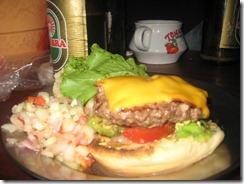
As a celebration to the end of the bike tour, we made burgers. So to you at home, this may not seem so special. But if you only understood the food here, you would understand why we took this task so seriously. We were divided into teams (strike forces) to buy ingredients. Then we made burgers. I was responsible for dishes (fun, right). There was quite a lot of planning involved in this. We don’t joke about a good burger here (because the ones you actually do find in Ouaga do not suffice). So we had our grill masters make the cheese burgers plus an assortment of toppings, including BBQ sauce, bacon, avocado, tomato, lettuce, onion, etc. I can confidently say it was the best burger on the continent of Africa.  IMG_4490 IMG_4496
There is an official Bike Tour Blog. Check it out for more pictures, stories, and info. You can also still support us with a donation! All the money funds projects done by volunteers here in Burkina Faso.

The next two days, I was at the 50th Anniversary Fair. It was really cool. The Fair Committee did a fantastic job with all of it. The Fair was a chance for volunteers to showcase their work and bring their association/community group to sell stuff, network, or sensibilize. Committees also had tables (that’s what I was doing, helping out with the Community Health and AIDS Task Force table. I’m on that committee). There’s a ton of great videos up on YouTube. I unfortunately can’t get the internet to download them that easily so will probably watch them in 10 months when I’m back. But you should check them out!

After the Fair, I went back to site for a week and am back in Ouaga now for a training of trainers. We are welcoming a new group of health volunteers to Burkina Faso on October 11 and I will be working at some point during their training.

I’m excited to get back to site. Between the nutrition training, Bike Tour, Fair, and training of trainers, I’ve been out of site the past 4 out of 5 weeks. And now that rainy season is almost over, as is harvesting, I can start picking up speed on projects. I am doing another FARN (rehabilitation program for moderately malnourished babies, the same thing I did back in May). The cool thing is I am working with the same counterpart from before plus two new ones who attended my nutrition training, so it gives me the chance to be more hands off and really empower them to have the confidence to do the program on their own (and ideally after I leave too…). We are doing it in one of my satellite villages. I also received some grant money to build 16 latrines, so will start that process again (although it should be easier the second time around). And as soon as school has started next week, I will be doing more health classes plus a pen pal program with the English class. Then in December, CHAT (Community Health and AIDS Task Force, which I am part of) is planning an activity for World AIDS Day, so I am involved in that. We are trying to get tons of volunteers to paint murals. We’ve done all the work to get the funding and will buy the materials, to make it as easy as possible for volunteers. So I will be doing a mural in my village and helping other volunteers do murals. Sounds like I’ll be busy, but a welcome change of pace. That’s just how Peace Corps goes – your first year is slow, the second is packed.

Wow, I know, super long update. I’ll be here until Saturday and then back the next weekend for meeting, so I’d love to hear from you (e-mail, facebook, gchat if it loads with my super slow internet, whatever works). Miss you and hope you’re doing well!

Erika

Sunday, September 25, 2011

CREN Training

Just finished my biggest project so far! I organized a nutrition training in my district capital. One was for the staff of the CREN (rehabilitation center for severely malnourished children) and one was for community health agents from some of the villages the center serves. It was a lot of fun, but a lot of work!!! Luckily, there are others volunteers in my same health district, so they helped out a lot!


So I’ll start with the training for the community health agents. Community health agents are volunteers from different communities that serve as liaisons to the CSPS (health clinic). They help with vaccination campaigns, health education, and community mobilization. The community health agents are absolutely fantastic in my area! I love working with them. For the training, there were two from each of the four CSPS’s in the district with a PCV, so eight community health agents in total. IMG_4426 The training was two days on the theme of nutrition. We chose to train people on the ground in the communities because one of the problems now is that there aren’t many referrals to the CREN. Since January of this year, there has only been 14 referrals. Not because there isn’t malnutrition, but because it’s not always identified on the community level and people don’t always understand the options available when a child is malnourished. The first day, they did sessions on nutrition education, identifying malnutrition, and responding to cases of malnutrition in their communities. The second day, they were trained on community mobilization (with the CREN staff) and the FARN (a rehabilitation program for moderately malnourished kids, see What Exactly Do You Do as a PCV). It was a lot of fun, but super exhausting. They did a fantastic job and I’m really excited to see what they do in their communities.


The other training was with the staff of the CREN (rehabilitation center for severely malnourished kids). This one was a little more complicated because it was a higher level (health professionals) and because it was ten days (although just one short session every day). IMG_4438 The first week, we talked about the proper functioning of a CREN, identifying malnutrition, treating malnutrition and the medical complications associated with it, nutrition education, and community mobilization. The second week, they were trained on enriched bouillie preparation (my counterpart from my village came to do this session), moringa, the administrative responsibilities of CREN, and ways to generate their own revenue. Right now, their budget is what’s left over from pharmacy profits, meaning little to nothing. So this is really important – they can’t function if they don’t have money to fund programs. So we talked about different things they can do – sell enriched bouillie packets, sell moringa powder, or search for outside financial partners – to meet their material needs and be more involved in more activities like education and prevention. The last day, they started an action plan. IMG_4446 I will go back in one week to review the rest of their plan and help them prepare it to present it to the MCD (the doctor in charge of the district/their boss). Overall, it went really well. I didn’t facilitate a single session – I got other PCVs, a PC staff member, and someone from a neighboring CREN to do different sessions. But it meant a lot of coordinating for me to do. I think that the biggest thing they took from the training was identifying what they want their CREN to look like and what they need to do to get there. Even just getting the four of them sitting in the same room talking about a CREN was a big deal. They all have other responsibilities within the district hospital too, so they don’t often dedicate much time to the CREN. Some of what they need to do is as simple as cleaning and rearranging the room they are in. Some is more complicated, like generating revenue to meet a long list of material needs. But hopefully with the support of the MCD, they can keep moving on what they’ve already started.


One other element was the mural we painted in the CREN building. We painted “the house of nutrition.” They do three food groups here – energies, constructors, and protectors – all of which coincide with a part of the house. I am so glad I worked with other volunteers on this because I’m not artistically talented at all! We included a mural for two reasons – for nutrition education and to liven up the room to make it more conducive to the rehabilitation of the patients. Picture below.IMG_4442