There’s a saying in French here “Ca va aller.” It basically means, “It’ll be fine” or “Don’t worry about it.” It’s a very useful saying here. It works when I’m frustrated about something, when I’m stressed out about something, or when I don’t know what’s going on. It also works when I don’t understand what people are saying to me in French. I say it and people seem to just laugh. I have a feeling that “Ca va aller” may be a theme throughout my next two years here…

Sunday, September 25, 2011

CREN Training

Just finished my biggest project so far! I organized a nutrition training in my district capital. One was for the staff of the CREN (rehabilitation center for severely malnourished children) and one was for community health agents from some of the villages the center serves. It was a lot of fun, but a lot of work!!! Luckily, there are others volunteers in my same health district, so they helped out a lot!


So I’ll start with the training for the community health agents. Community health agents are volunteers from different communities that serve as liaisons to the CSPS (health clinic). They help with vaccination campaigns, health education, and community mobilization. The community health agents are absolutely fantastic in my area! I love working with them. For the training, there were two from each of the four CSPS’s in the district with a PCV, so eight community health agents in total. IMG_4426 The training was two days on the theme of nutrition. We chose to train people on the ground in the communities because one of the problems now is that there aren’t many referrals to the CREN. Since January of this year, there has only been 14 referrals. Not because there isn’t malnutrition, but because it’s not always identified on the community level and people don’t always understand the options available when a child is malnourished. The first day, they did sessions on nutrition education, identifying malnutrition, and responding to cases of malnutrition in their communities. The second day, they were trained on community mobilization (with the CREN staff) and the FARN (a rehabilitation program for moderately malnourished kids, see What Exactly Do You Do as a PCV). It was a lot of fun, but super exhausting. They did a fantastic job and I’m really excited to see what they do in their communities.


The other training was with the staff of the CREN (rehabilitation center for severely malnourished kids). This one was a little more complicated because it was a higher level (health professionals) and because it was ten days (although just one short session every day). IMG_4438 The first week, we talked about the proper functioning of a CREN, identifying malnutrition, treating malnutrition and the medical complications associated with it, nutrition education, and community mobilization. The second week, they were trained on enriched bouillie preparation (my counterpart from my village came to do this session), moringa, the administrative responsibilities of CREN, and ways to generate their own revenue. Right now, their budget is what’s left over from pharmacy profits, meaning little to nothing. So this is really important – they can’t function if they don’t have money to fund programs. So we talked about different things they can do – sell enriched bouillie packets, sell moringa powder, or search for outside financial partners – to meet their material needs and be more involved in more activities like education and prevention. The last day, they started an action plan. IMG_4446 I will go back in one week to review the rest of their plan and help them prepare it to present it to the MCD (the doctor in charge of the district/their boss). Overall, it went really well. I didn’t facilitate a single session – I got other PCVs, a PC staff member, and someone from a neighboring CREN to do different sessions. But it meant a lot of coordinating for me to do. I think that the biggest thing they took from the training was identifying what they want their CREN to look like and what they need to do to get there. Even just getting the four of them sitting in the same room talking about a CREN was a big deal. They all have other responsibilities within the district hospital too, so they don’t often dedicate much time to the CREN. Some of what they need to do is as simple as cleaning and rearranging the room they are in. Some is more complicated, like generating revenue to meet a long list of material needs. But hopefully with the support of the MCD, they can keep moving on what they’ve already started.


One other element was the mural we painted in the CREN building. We painted “the house of nutrition.” They do three food groups here – energies, constructors, and protectors – all of which coincide with a part of the house. I am so glad I worked with other volunteers on this because I’m not artistically talented at all! We included a mural for two reasons – for nutrition education and to liven up the room to make it more conducive to the rehabilitation of the patients. Picture below.IMG_4442

Wednesday, August 31, 2011

Wow, so I’ve officially been at site for one year now! August 31. Crazy. It really does take the entire first year to figure out what the heck you are doing here. Grassroots community mobilization and development is much harder on the ground than it is to think about it or talk about it during training. So I wish I could say I celebrated my one year anniversary in some really exciting way. But I was in the regional Peace Corps office until almost midnight making copies for the training I’m doing (see below). Feels like college again.

I’ve been planning a training with the CREN (center for severe malnutrition). The CREN is in my district capital, but it serves my community and all the others in our health district. It’s actually two trainings, one for the four staff members of the CREN and the other for eight community health agents (community volunteers who work with the health clinic on community mobilization and help out with vaccination campaigns). I’m excited for it to start and I think it will go really well. It starts the 5th of September and will last 2 weeks. We’re covering lots of different things based on the needs discussed with the CREN staff and the MCD (doctor in charge of the district). The topics we have are: identifying and treating malnutrition, enriched bouillie (pourridge) preparation, moringa, community mobilization, and the functioning of a CREN – keeping records, revenue sources, and budgeting. I’m not facilitating any sessions, but I’m organizing all of it – who’s coming to do what sessions, what the objectives are, and all the logistics. It’s been challenging, particularly because a lot of the work I can’t do in village. It either involves meeting with people at the district capital or preparing materials, which requires a computer, electricity, and a printer. It’s also complicated because it’s two different trainings running at the same time – one for the CREN staff (medical professionals) and one for the community health agents. It is also much more official/the big leagues than projects in village. But I think that it really addresses the needs of the CREN and most importantly will encourage collaboration between the district and the communities, which is crucial to the functioning of the CREN because it can’t function in the community level does not refer patients to it (which is one of the major problems right now). Will let you know how it goes next time!

I was trying to explain to my brother the other day that planning the training was stressful, but had a tough time explain stress to my brother in French. I looked it up in the dictionary, but he didn’t know the word. The dictionary listed another word too and my brother knew the word, but I’m not sure that it has the same meaning. He told me that he doesn’t know a word in Bissa for stress. I just think that’s interesting – that stress isn’t really a word used in village, but it’s definitely used all the time in America! The mentality here always is “Ca va aller,” it will go on. But we Americans seem to be stressed out about something all the time.

IMG_4403 Yesterday was Ramadan, the end of the month-long fasting period for Muslims. It’s a big fete in village. It was fun to see everyone all dressed up, to eat, and to go around and greet people. Unfortunately, it rained all evening so ended the party a little bit early. I got some really cute pictures of my nephews! The one is the suit is Aziz, my brother Drissa’s son. The other is Walilo, my cousin’s son, who recently moved in with us and will live with us for a while. IMG_4404 IMG_4410

IMG_4397 I’ve also been busy cultivating my peanuts! Right now is rainy season, so it’s the time everyone plants in their fields, cultivates, and harvests. I planted peanuts, mostly just to understand what it is like to cultivate and the lifestyle here. I didn’t plant much, but it's more work than I expected. It is surprisingly relaxing to do physical labor (just a little bit each day though). Here’s some pictures of my field! IMG_4395

So I will spend the next two weeks in my district capital for the training. Then after that, I am participating in the Bike Tour. I am participating in 5 days. I am joining on route to my district capital where they will pass one of my satellite villages. Then from my district capital, we bike to three other cities before we get to the capital. The first day I will only bike part of the route, about 33 km. The second day, I will bike about 80 km. Then 125 the 3rd day, 80 the 4th, and 85 the 5th. I’ve been attempting to train… The Bike Tour is a tour of the entire country by bike over 3 weeks. It is a fundraiser for gender and development projects carried out by PCVs here in Burkina Faso. For more information or to support us, check out : http://burkinabiketour.blogspot.com/

Well that’s it for now. I will be back in the capital around September 22nd after the Bike Tour and to celebrate the 50th Anniversary of Peace Corps, so I’d love to hear from you then, either e-mail, facebook, skype, snail mail, whatever works!!!

Miss you and love you!

Saturday, August 6, 2011

Rainy Season!

Rainy season is so cool – all of a sudden a huge rain storm that stops everything will come in.  I love watching them.  Pictures from the first real rain storm this season (from my latrine).

On the note of rainy season, I have decided to plant and harvest peanuts this year.  Will update soon…


rainy season 1 rainy season 2

Mid Service Conference`

At our mid-service conference now.  (Can you believe I’ve been here over one year now?!)  It’s definitely been a great morale booster and I love hearing about the cool things other volunteers are doing at site and getting ideas for my own projects. I’m excited about getting some great stuff done at site and am starting to see that I really can have an impact here. It’s also great having people to relate to and who understand the experience. The connections you can make when you all experience something so intense together are amazing and I didn’t really feel it until today.

One year in is a good point to look back and reflect. I’m happy with some projects I’ve done. We’ve definitely had a tough year here and I did the best I could in a difficult situation. But there’s still so much more I can do. I’m not done here yet. Although it’s challenging to extents I never imagined, I wouldn’t want it any other way. Despite the many times we sit and complain about site, the weird cultural things, how frustrating development work can be, being called “nasara” and constantly asked for money, and a million other things, we didn’t join the Peace Corps to do something easy. We wanted to challenge ourselves and to grow. I’ve been learning to appreciate the bad along with the good and I’ve developed a patience for it. I don’t want my service to be perfect. It wouldn’t be any fun that way. I want the difficulties, the frustrations, and the things that go wrong and I wouldn’t change them because of what I’ve learned from them. At the risk of sounding super cliché, the bad things made the good better. Those things all together make my service what it is. Frustrating, challenging, sometimes demoralizing, but all in some really weird way, empowering and fulfilling. And I hear the second year just gets better…

Thank you all for your thoughts, love, and support. Thank you for verbalizing that – whether it was a letter, package, phone call, e-mail, comment on my blog, or Facebook message. It really does keep me going and gives me just the encouragement I need. Lots of love!

Sunday, July 17, 2011

So what exactly do you do as a PCV…

So a long time overdue – but I will try my best to update you as much as possible! Lots going on here, so I’ll break it up into three blog posts. I usually get questions about what projects I’m doing and what life in like in village, so I’ll start with those. The last post is just fun stories I would only experience as a PCV.

So what exactly do you do as a Peace Corps Volunteer…

It good to finally be feeling busy with work! I’ve gotten to do a lot of cool things and I’m excited for some other projects in the works. April and May were really busy because I was trying to finish things up before rainy season. During rainy season, everyone goes out into the fields to cultivate, so people are really busy, meaning projects are more difficult. I’ve done most of my work on nutrition and hygiene, but I’m hoping to get more into family planning, HIV/AIDS, and maternal health in my second year. (Can you believe it, I’ve been in country for over a year now!!!)

Nutrition:

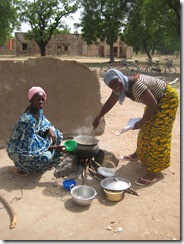
My big project was the FARN or hearth model. It’s a rehabilitation program for moderately malnourished kids. We weighed babies in two villages in March to identify malnourished kids to participate. Every morning for 12 days, we met to make an enriched bouille (porridge) and talk about health. IMG_4306 We started off talking about nutrition and then moved on to other topics like family planning and hygiene. My counterpart for this project is absolutely amazing!!! She is the volunteer in maternity and lives in one of our satellite villages. She’s so positive and really motivated and excited about working on nutrition.IMG_4307 We had 6 women participate in the program. The cool thing about the program is that it is really all about empowering the mothers. The bouille is made from ingredients found locally and the women all contribute resources to buy the ingredients, so they know they have the ability to properly nourish their kids with the resources they have. The moms were all fantastic and I had a lot of fun hanging out with them every morning. Most of the babies were afraid of me, but by the end of the 12 days, they got used to me and would even sometimes let me hold them. Assetou is my favorite, mostly because she was the only one totally comfortable with me holding her and would play with me. The others were more hesitant.IMG_4309 All of the babies gained weight after the 12 days, which is awesome. But definitely have ideas to change it next time around. Most of the babies didn’t gain weight during the month after (although it is hard because June is a tough month because people run out of their food stock from last year’s harvest and they haven’t harvested yet for this year), so I want to focus more on the nutrition education and what the moms can do at home. But not bad for the first. Definitely learned a lot and have lots of ideas for next time. That’s why Peace Corps is two years, not just one.
Hygiene

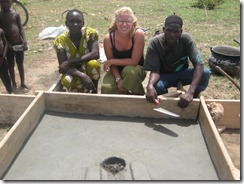
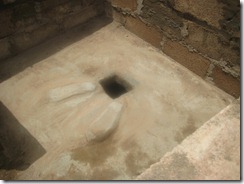
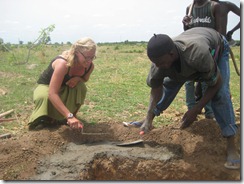
In my last post, I mentioned a latrine training I went to with two counterparts from my village. (So I sometimes forget what words aren’ t part of general American vocabulary. A latrine is the hole in the ground that is your bathroom. You dig a deep hole, put a cement square over it that has a small hole, and build a house around it.) IMG_4320 The training focused on hygiene and then how to actually build latrines. I brought the only female Burkinabe to the latrine training. latrine formation Construction is generally a male job and it can definitely be intimidating to be the only female Burkinabe, but my counterpart stepped up and did a really awesome job. The first female mason of my village now! IMG_4343 Her name is Sibi and she’s so much fun to work with. Really positive and enthusiastic.
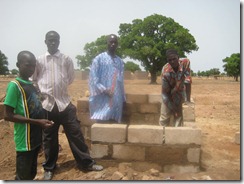
It was definitely a slow and frustrating process getting the latrines started. When you only have the funding for two latrines, its really hard to pick just two places out of so many options! And the politics of it all – getting it approved by all the important people. We finally decided on one mosque and one church (I’ve had trouble figuring out percentages of religious affilation in village. IMG_4317 I’ve heard that my village is 50/50, Muslim/Catholic or Protestant. But I’m not so sure that’s accurate. But I also work in a health center that serves 16 villages. There are some villages that are predominately Muslim and some that are more split.) Anyways, we built in two different villages. After the building of the latrine, we talked at the Friday afternoon prayer (mosque) and Sunday morning service (church) about hygiene and the importance of latrine use. It would sure be a waste to build a latrine if we never explained why it was important to use it (thus encourage people to actual use it). We’re hoping to do more latrines after rainy season.

IMG_4342

IMG_4318


IMG_4345

IMG_4339


IMG_4347 IMG_4349


During the hygiene talk at the church, the women’s choir at the church asked me to come back teach them how to make soap to sell and promote hygiene. So I went back the next week to plan and then two weeks later to make the soap. The women decided to start with liquid soap because the start-up costs are less. The eventual goal is to use the profits to invest in hard soap making. The ingredients are much more expensive. Soap making is a great activity in Burkina Faso because it is a way to generate income and promote good hygiene practices at the same time. And while making soap, it’s a great opportunity to explain how soap works. I actually didn’t know this before (and excuse the very basic explanation, I was never very interested in chemistry), but soap works because a chemical reaction suspends oil and dirt and then you wash that off with running water. While running water isn’t an issue in the States, it’s important to explain this process while talking about soap because there is no running water here. But you can substitute pouring water, but lots of people often just dunk their hands in a bowl to wash the soap off, which doesn’t work then. And I’ll admit – I used to do that too. I thought soap killed stuff. But it suspends the bad stuff to be washed away. Learn something new every day.


Health Education:

I’ve also been trying to do as much basic health education as possible. In March and April, I went to two different literacy centers to talk about health. In one, we talked about pre-natal consultations – why they’re important and the appropriate schedule for them. At another literacy center, we talked about nutrition, hygiene, and malaria. But I think my favorite thing I’ve done so far is the health classes at the middle school/high school. I talked to the equivalent of the 7th, 8th, 9th, and 10th grade classes (although the corresponding ages tend to be older) about hygiene. It was a lot of fun to work with students again – teenagers are always teenagers, no matter where they are. For the oldest class, I taught them the health terms in English as well. Next school year, I am hoping to work a lot more with the school. The director is awesome and really supportive.

Upcoming projects:

Moringa garden at the CSPS: Morigna is a tree with really nutritious leaves – tons of vitamins, iron, and other good stuff. We are planting morigna at the CSPS and hopefully selling the leaves in powder form (to add to sauces or bouille/pourridge) and using the profit to subsidize bi-monthly or monthly enriched bouille demonstrations at the CSPS after baby weighings.

Training at the CREN: The CREN is a center for the rehabilitation of severely malnourished children. While moderate malnutrition is addressed on the community level, severe malnutrition needs to be treated at the district level – it requires more intense medical supervision. I am working with a neighboring volunteer on this project. Because nutrition is something we’ve spent a lot of time on in our respective villages, we want to work at the district level as well to ensure that our efforts in village are complemented by support in the district. We’ve planned a training that covers the identification and treatment of malnutrition; nutrition education and enriched bouille preparation; community outreach and mobilization; and financing and administration of programs at the CREN. We’re aiming right now to do this the last two weeks of August.

What’s it like living in a village?

Okay, so I’m kinda late answering the question, mostly because it’s a really hard thing to describe. After one year, things have become quite normal for me. Like going to the pump or attaching a pagne (basically a large piece of cloth that you wear as a wrap skirt). But as I write this, I am on my way to visit my Mom in Italy and I just had quite an overwhelming experience at the Paris airport. So seeing all that again puts village life in perspective again.

My village is everything you’d imagine Peace Corps to be – no running water, no electricity, and a hole in the ground for a toilet. But those are the easy adjustments. It’s in the bush, but really laid back. I bike everywhere and it’s beautiful (mostly just during rainy season).

The upsides of village life:

· Awesome family! I live with an infinitely fantastic family! IMG_4377 They’re so welcoming, supportive, and just lots of fun. They take really good care of me. Sometimes I feel bad because they always have to help me – get the bats out of my house, explain things, decipher my French and Bissa. But then I think about the laughs they get from having the crazy nasara live with them. I was burning my trash one night and it was already dark. I had already lit it and was waiting for it to burn down. My family was hanging out outside and could see me. Near the fire, I saw a bug that to me looked like a baby scorpion or something. And I hear those bites are really painful. IMG_4386 So naturally, it freaked me out. It started to crawl towards me, and obviously I started to run. Meanwhile, my family is just looking over at me, seeing my run in circles around my burning trash. I’m sure I looked totally ridiculous, but makes life more fun, right?

· Always someone around to help you. Whether I need help finding something in the marche, bargaining for a good price, or fixing a stove that lights on fire when I cook, someone will also help me when I ask. Although this doesn’t always work with finding places if I’m lost – I’m not sure what it is, but they’re not really good at giving directions here.

· Slower pace of life. Taking time to get to know people. Caring about how people’s family, work, and life are going. Always being greeted with a smile.

The hardest parts of village life are the cultural adjustments and not understanding things. Just being in a place where there are days where nothing seems to make any sense at all. It’s a tough thing to describe, but I’ve learned to live in a state of somewhat confusion all the time. No running water, no electricity, those things are easy. It’s living in a completely different cultural context that is difficult. Things that make sense or are obvious back home aren’t here and the things that do here, aren’t the same back home.

A lot of what Peace Corps is about is integrating into your village (to gain respect and trust to serve as a foundation of your work). So I do spend a good bit of time getting to know people in my community – hanging out with my family, going to the market. Marche days are big social events. There’s a marche in my village and a grand marche 3 km away. My marche is pretty small, but plenty of benga (beans and rice), which I am known for eating all the time. My grande marche used to be really overwhelming. It’s much bigger and people from all around come, so not everyone knows me as well (at least when I first got here). I was constantly called at and people would constantly greet me. But now I love going and it feels so much more comfortable. I usually go just to say hi to people and talk to my friends. Those sorts of relationships and taking time to do those sorts of things are really important to the life of a PCV in Burkina Faso, which is a refreshing change of pace.

Only As a PCV…

I celebrated my birthday in village. The actual day of my birthday was exhausting because we did a vaccination campaign (meaning we went door to door to give polio vaccines to kids). April, by the way, is hot season although it’s basically always hot. And in the late afternoon, I had to go with my counterpart to visit families to talk to them about our malnutrition program. But the next day, a neighboring volunteer came over and we (and by we I actually mean my brothers because that’s why I have brothers) killed one of my chickens (see story below), and cooked a delicious meal – curried rice and jerk chicken (all Takiyah’s doing. I just got the charcoal going). It was delicious!

So my chickens… my oldest brother (Drissa) is really into animal raising. (Animal husbandry I think is the real word in English, elevage in French). He has goats, cows, pintards (guinea fowl, it’s probably the stupidest bird besides turkeys. They get stuck in my latrine and can’t figure out how to get out), turkeys, and chickens. He really wanted to me buy a chicken so it could take care of the pintard eggs so that I could have my own eggs to eat. I still don’t really get why the pintard takes the chicken eggs, but whatever. Anyways, I was in a larger city and decided to by the chickens there since they were cheaper. And then took them on a 3 hour bush taxi ride and a 13 km bike ride. I named them Lucy and Ethel after I Love Lucy. My bag with cans of tuna fell on Lucy during the bush taxi ride, but she seemed to recover. Ethel did not like the bike ride. Wish I took a picture. Anyways, I got home and gave them to my brother (because I don’t really know what I’m doing with them). The next day, he informs me they’re not chickens but roosters. Meaning they won’t take the eggs. Oh well. Guess I should rethink the names, but we ate Lucy for my birthday. The other was a gift to the volunteer in a neighboring village, so Ethel biked 33 km with me to the other village.

I’ve been starting running a lot more in village, which definitely gets a fun reaction from my community. In the evenings, if I run about the time school gets out, the primary school kids will run with my for a little bit. There’s actual two girls who do surprising well keeping up. It’s kinda fun always having encouragement, although most people just laugh (loving of course, but still laughing) when they see me running. Although I think altogether most people are just confused as to why I would want to tire myself out for fun – life is already exhausting here, going to the pump, handwashing landry, and cultivating in the fields. But I consider this a huge success – my 23-year-old sister has started running! When I first started, my brothers would occasionally run with me, along with the family dog. But one evening, my sister and her friend decided they should start running too. My sister went to school in the capital city for a little bit, so she’s not so “villageois” anymore and at her school, she did sports as part of school, so it’s not the first time she’s run. But I still think it’s really cool for girls to see a young woman from their village run, not just the crazy nasara.

Some other new and exciting news….

I got a radio/cassette player. So if you don’t want to write a letter, you can record on a cassette tape and I can listen to your voice!! Or you can record random conversations or everyday happenings to make me feel like I’m at home with you!

I also got a kitten. IMG_4372 Really adorable. He’s quite a baby and spoiled. He’s constantly at my feet and cries when I leave. When I sleep inside, he likes to sleep by my feet. When I sleep outside, I don’t let him in my tent (a – my family would think I’m totally weird if they don’t think I’m weird already and b – I don’t want him peeing in there). IMG_4369 So he decides to find other people to cuddle with. That doesn’t go over well with Burkinabe. I got him because of a terrible mice problem – eating through my wood counter and my clothes and pooping on all my dishes.

A nurse at the health clinic is looking for an American pen pal. So let me know if you are interested! It would be really cool if someone who did something in health wanted to write with him, I think he’d like that, but it’s really just about learning about America and learning English. You can e-mail letters to me and I can e-mail you his letters. Or snail mail if you prefer the excitement.

Miss you all so much and think about you everyday!